Although not a new phenomenon, anti-Muslim rhetoric across the country has recently intensified, and it impacts religious liberty for everyone. The Texas primaries exhibited a pattern of certain candidates evoking fears of “Sharia law” being pushed onto Americans, but also attacks on Islam and Muslims more broadly. It’s clear that this talk alienates American Muslims and perpetuates discrimination, but it also translates into bad policy that undermines religious freedom for everyone. This report explores these topics.
The First Amendment and Religious Liberty
State-established churches were the norm in early America, and the government compelled colonists of all faiths to pay taxes to support them, restricted voting and public office by faith, and could punish sins as crimes. Minority faiths, Quakers being a well-known example, were sometimes subjected to violence or executed for their faith. Attitudes had shifted considerably by the time of the Revolutionary War, largely due to the Enlightenment’s impact on religious plurality and tolerance.
The First Amendment to the United States Constitution guarantees religious freedom through the separation of church and state. It reads “Congress shall make no law respecting an establishment of religion, or prohibiting the free exercise thereof; or abridging the freedom of speech, or of the press; or the right of the people peaceably to assemble, and to petition the Government for a redress of grievances.” Let’s break this down simply:
Congress shall make no law…
The amendment applies to the government or its agents – including state governments – not private parties.
…respecting an establishment of religion…
Known as the Establishment Clause, it prohibits the government from establishing a religion, which includes preferring religion over nonreligion or preferring one religion over another. Founding Father and religious liberty crusader, Thomas Jefferson, characterized this concept as the “wall of separation between Church and State.” Most Establishment Clause cases involve prohibiting public schools from sponsoring religious activity, such as an official school prayer.
…or prohibiting the free exercise thereof;…
Known as the Free Exercise Clause, it prohibits the government from interfering with individuals’ expression of religious beliefs, so long as that expression does not harm others. Most Free Exercise cases do not involve laws that directly discriminate against a specific denomination, but rather general laws that hurt a particular religious group.
The Establishment Clause and Free Exercise Clause work together to ensure that the government neither promotes nor harms religion. A longstanding disagreement, however, pits two interpretations against each other: a “separationist” approach, which emphasizes strict government neutrality through non-involvement, and an “accommodationist” approach, which holds that government may recognize and extend benefits to religion so long as it does so in a non-discriminatory manner.
Religious liberty protections, and the First Amendment more broadly, were designed to protect unpopular minorities throughout times of political change. Justice Robert H. Jackson said it best in his majority opinion for West Virginia State Board of Education v. Barnette (1943):
“The very purpose of a Bill of Rights was to withdraw certain subjects from the vicissitudes of political controversy, to place them beyond the reach of majorities and officials… One’s right to life, liberty, and property, to free speech, a free press, freedom of worship and assembly, and other fundamental rights may not be submitted to vote; they depend on the outcome of no elections. . . .”
Christian Nationalism
Generally speaking, conservatives’ views on religious freedom in America can be summed up by Texas Lt. Gov. Dan Patrick, who stated:
“It is time to set the record straight: there is no such thing as ‘separation of church and state’ in the Constitution. For too long, the anti-God left has used this phrase to suppress people of religion in our country.”
More often than not, the religiously oppressed people they refer to are Christians. In 2025, Trump created a Task Force to Eradicate Anti-Christian Bias as well as a Religious Liberty Commission (chaired by Lt. Gov. Patrick) to protect against threats to religious liberty, including targeting peaceful Christians. This perceived victimization of Christians goes hand in hand with a concerning trend: the growing influence of Christian nationalism.
The Baptist Joint Committee for Religious Liberty defines Christian nationalism as a political ideology and cultural framework that tries to merge American and Christian identities into one. This manifests politically as the belief that Christianity should be privileged in American law and public policy, directly countering the separation of church and state. Texas is no stranger to the preferential treatment of Christianity; some recent examples include:
- allowing chaplains to act as school counselors (TEA staffing data shows only 6 chaplains employed throughout Texas for the 2025-26 school year);
- requiring the display of the Ten Commandments in public schools (recently upheld by a Federal appeals court, but an appeal is likely);
- sending tax dollars to religious schools (award notices being rolled out now after failed attempts by Comptroller Hancock to exclude particular Muslim schools for alleged ties to terrorism); and
- a State Board of Education-proposed social studies curriculum that has drawn scrutiny for its overemphasis on Christianity (final vote is expected in June), among others.
Christian nationalism suggests that to be a “real American” or “real Texan,” one must be a Christian, but not just any kind of Christian, usually one who holds fundamental religious beliefs in line with conservative political priorities. The term “white Christian nationalism” is also used to emphasize its overlap with white supremacy and the belief that cultural belonging is limited to a very narrow group of people: those who held the rights of citizenship at the beginning of this country, which were white, Protestant Christian men who owned property. Anti-Muslim attacks play into this worldview.
“Sharia Law” vs. Reality
In March, Rep. Brent Money and a group of Texas House members formed the Sharia Free Texas Caucus, following the lead of Texas Congressmen Chip Roy (TX-21) and Keith Self (TX-03), who founded the Sharia Free America Caucus in December 2025. Both groups aim to “counter the alarming rise of Sharia Law in the United States.”
Hardliners use “Sharia law” as a catch-all for longstanding fears and misconceptions about Muslims in the U.S., shaped by 9/11, extremist groups, limited exposure to Muslim communities, and anxiety about a diversifying country. The term is rarely used accurately in reference to the Quran or Islamic practice; instead, it is invoked as a vague threat to American values.
In reality, Sharia is a personal moral guide for Muslims; it is the guidance Muslims believe God provided them on a range of spiritual and worldly matters, derived from the Quran and Hadith (the sayings and practices of the Prophet Mohammed). In a recent interview, Rep. Bhojani, who founded the Religious Freedom Caucus, explains that Muslims don’t all follow the same Sharia law — it’s context, cultural, country specific. Interpretations and applications of Sharia vary widely.
Religion and the Law
At the macro level, there are intersections between Islam and the law, as discussed by the Council on Foreign Relations. About half of the world’s Muslim-majority countries have some laws based on interpretations of Sharia, which are typically applied to civil matters, rather than criminal law or punishment. Even then, Non-Muslims are not expected to obey Sharia, and are under the jurisdiction of special government committees and adjunct courts in most countries.
Some countries, with and without large Muslim populations, allow religious institutions to settle civil matters, typically marriage, divorce, inheritance, and guardianship, alongside a secular judicial system.
Extremist groups enforcing Sharia are something else entirely. Experts contend that leaders of such groups often have little to no training in interpreting Sharia and use a puritanical interpretation as a show of rebuking Western influence.
U.S. Courts
U.S. courts cannot enforce Sharia law, or any foreign law in conflict with the Constitution.
Unlike international law, which is generally accepted as U.S. law, foreign law — the laws of a foreign country — is not and may be applied only if it does not violate public policy, including the U.S. Constitution or any applicable state Constitution. Under this standard, foreign law is routinely used in U.S. courts as a practical matter in an age of globalization. Some routine examples of foreign laws’ intersection with U.S. courts include:
- State courts are regularly called upon to determine the validity of a marriage entered into abroad. They will typically do so in accordance with the law of the country where the marriage took place.
- In transnational business transactions, a contract may specify the laws of other nations as governing.
- Courts may rely on foreign law in settling disputes relating to employment with a foreign company that is governed by the laws of that company’s home country.
Additionally, when individuals choose to resolve family and property disputes through religious arbitration rather than the courts, they may seek the courts’ help to enforce an agreement or award. However, courts can still refuse to confirm or vacate an outcome that violates the law or was agreed to under fraud or duress, as they could in any arbitration matter.
After Oklahoma’s 2010 constitutional amendment banning Sharia law was struck down as unconstitutional, states have sought to meet the same end goal by banning foreign law in state courts. In 2017, Texas passed HB 45 to limit the Texas Supreme Court from granting comity to a foreign judgment or arbitration award involving a marriage or a parent-child relationship. Critics of the law regard it as redundant, as the State Family Code already specifies circumstances in which foreign laws cannot apply, including when they conflict with the safety of the child or Texas law. More information on how the State plans to further similar laws may come to light during the interim, as House Speaker Burrows included a charge to review HB 45’s implementation and explore whether Sharia law or any other foreign law has permeated the Texas judicial and legal system.
Bottom line: the Supremacy Clause, the public policy requirement, and existing judicial review of arbitration awards already prevent foreign or religious law from overriding constitutional rights. Whether “Sharia-free” hardliners frame a bill as an outright ban, a reinforcement of existing law, or a clarification, its impact is more political than practical and further risks alienating Muslim Americans. Furthermore, there are risks of unintended consequences. Foreign law bans undermine the carefully calibrated mechanisms that courts have developed to deal with foreign and international law and threaten to disrupt routine uses of such law in state courts and arbitrations.
Defending Church-State Separation
A robust wall of separation works best for the religiously diverse nation that we’ve become. Even though Christianity is the majority religion at both the state and national levels, it is not monolithic, comprising thousands of denominations. Of the 67% of Texans who identify as Christian, the largest subgroup, classified by Pew Research Center as Evangelical Protestant, includes roughly 50 denominations. The next largest plurality is religiously unaffiliated Texans.
Pew Research Center, Texas Religious Composition, 2023-24
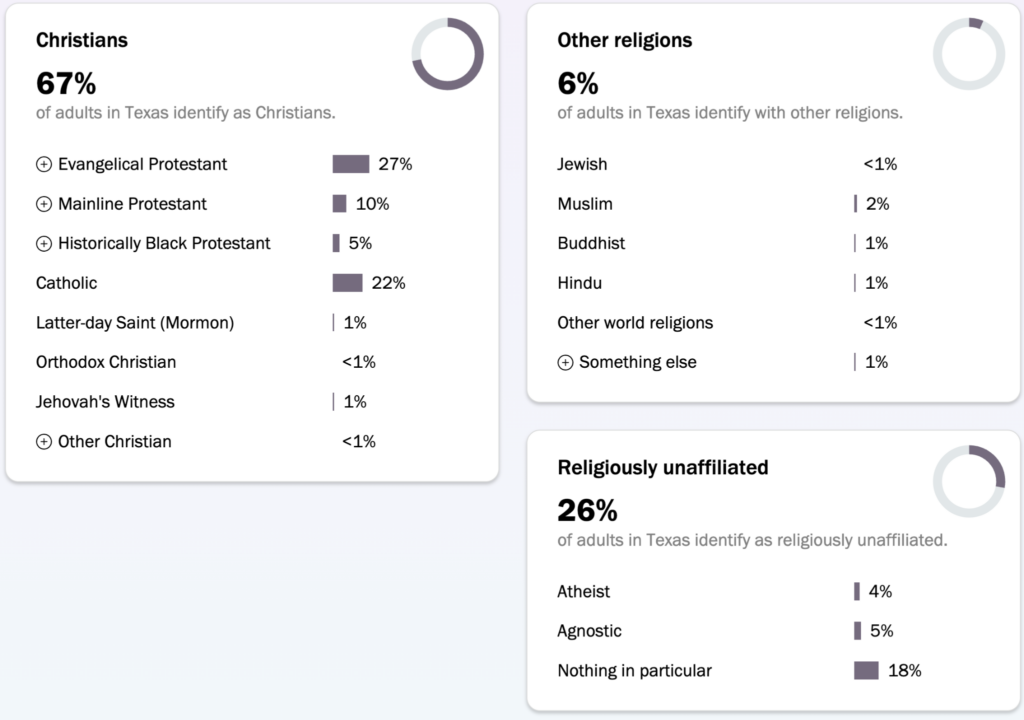
Given the diversity within religions, it may be more accurate to describe the U.S. as a nation of religious minorities, undercutting the “majority rule” argument.
We are indeed facing an uphill battle: a Texas trifecta uplifting Christian nationalism, a complicit White House, and a supermajority in the Supreme Court. But Texans are taking note; a poll by Americans United found that a strong majority of Texans feel that religious freedom is under threat, and that the separation of church and state should be protected. Texas leadership has been aggressive in pushing laws designed to provoke Supreme Court review or test the existing constitutional doctrine. Texas legislators must continue to fight against discriminatory laws and the creep of Christian Nationalism, not just for their constituents but for all Americans.